
Artificial Intelligence for Prediction of Cost and Schedule Performance in Nigerian Construction Projects: A Systematic Review and Future Directions
-
Simon Adinoyi Enebe
Department of Quantity Surveying, School of Environmental Technology, Federal University of Technology Minna, Niger State, Nigeria
Muhammad Sani TswakoDepartment of Quantity Surveying, School of Environmental Technology, Federal University of Technology Minna, Niger State, Nigeria
Jesse LetsuwaDepartment of Architecture, Computing and the Built Environment, Faculty of Science and Engineering, University of Wolverhampton, United Kingdom
David Chinonso Anih

Department of Biochemistry, Faculty of Biosciences, Federal University Wukari, Taraba, Nigeria
| Received 12 Apr, 2026 |
Accepted 22 Jul, 2026 |
Published 30 Jul, 2026 |
Artificial intelligence is increasingly influencing construction project management by strengthening the prediction of cost and schedule performance, two of the most important indicators of project success. This systematic review examined recent peer reviewed literature on the application of artificial intelligence in construction forecasting, with emphasis on cost overrun, time overrun, project delay, and the practical implications for Nigerian construction projects. Guided by PRISMA 2020, the review synthesized evidence published between 2020 and 2026 and screened 1,042 records, of which 35 studies were retained for the final review. The evidence shows that artificial intelligence has advanced from basic neural network approaches to more sophisticated ensemble, hybrid, and explainable models. These methods are increasingly applied to complex project datasets that include project size, contract type, labour productivity, material quantities, BIM outputs, site records, and planning information. Across the literature, artificial intelligence demonstrated strong potential for improving both cost estimation and schedule prediction, particularly in situations where traditional approaches are constrained by incomplete data, static assumptions, and subjective judgment. However, the review also found that model performance varies considerably depending on data quality, feature selection, validation strategy, and the extent to which training data reflect real project conditions. The evidence base remains concentrated in digitally mature settings, while Nigerian studies are comparatively limited and often focus more on readiness, barriers, and adoption conditions than on direct predictive modelling. In the Nigerian context, key constraints include weak data structures, limited technical capacity, poor digital integration, inadequate infrastructure, and resistance to organisational change. At the same time, important enablers were identified, including leadership commitment, training, policy support, and gradual integration of artificial intelligence into existing project workflows. Overall, the review concludes that artificial intelligence offers a credible route for improving construction cost and schedule prediction, but its usefulness in Nigeria will depend on stronger data systems, local validation, explainable modelling, and phased implementation. Future research should prioritize Nigeria specific datasets, real project pilots, and BIM-integrated forecasting systems that support reliable and context sensitive decision making.
| Copyright © 2026 Enebe et al. This is an open-access article distributed under the Creative Commons Attribution License, which permits unrestricted use, distribution, and reproduction in any medium, provided the original work is properly cited. |
INTRODUCTION
Artificial intelligence is becoming a major force in construction project management because the industry continues to struggle with cost growth, time overruns, weak forecasting, and uncertainty across planning and execution stages. Construction projects are especially vulnerable to budget slippage and delayed delivery because they depend on many interrelated variables such as incomplete design information, changing market prices, labour productivity, site conditions, procurement disruptions, and coordination failures among stakeholders. These pressures make cost and schedule performance two of the most important indicators of project success. Recent research has shown that machine learning and related predictive methods are increasingly being used to improve cost estimation because traditional approaches often depend too heavily on static assumptions, limited historical records, and subjective expert judgment1.
The growing relevance of artificial intelligence lies in its ability to process large and complex datasets, learn hidden patterns, and support earlier and more accurate prediction of project outcomes. In construction, AI is now being applied to forecasting, monitoring, optimisation, and decision support, especially where managers need faster warnings about likely cost escalation or schedule delay. Studies published in recent years have shown that AI can improve the quality of project control by helping practitioners detect risk signals before they become expensive failures2,3. This shift is important because predictive systems can support better decisions at the tendering, planning, execution, and monitoring stages, rather than waiting until a project is already in distress.
The development of AI in construction project management has also moved from simple rule based systems toward more advanced machine learning, deep learning, and hybrid modelling strategies. These newer methods are more flexible because they can combine structured data such as project size, contract type, and duration with unstructured information such as text, images, and field records. Recent reviews suggest that the most common uses of AI in construction now include prediction, optimisation, decision making, and performance improvement, with rapid expansion in the last few years3-7. In parallel, more recent predictive studies have demonstrated that hybrid neural models can estimate both final cost and project schedule with strong accuracy, showing that AI is no longer only an emerging idea but a practical forecasting tool with measurable value6.
In Nigeria, the need for such tools is even greater because the construction sector still faces persistent overruns, project delays, weak digital integration, and uneven adoption of modern project technologies. Evidence from recent Nigerian research indicates that stronger digitalisation is associated with better project delivery, which means that low adoption continues to limit performance across the sector4. This problem is reinforced by broader concerns identified in the AI literature, including poor data quality, implementation cost, resistance to change, and a shortage of technical skills. For this reason, a focused review of AI for predicting cost and schedule performance in Nigerian construction projects is both timely and necessary.
Although the literature on AI in construction has expanded rapidly, there is still no sufficiently focused synthesis on how these tools are being used specifically for forecasting cost and schedule outcomes in Nigerian construction settings. Some studies examine AI in construction generally, while others concentrate on cost estimation or adoption barriers, but few connect prediction methods with the realities of a developing construction market5. This creates a clear research gap. The present systematic review is therefore designed to identify the major AI techniques used in construction performance prediction, evaluate their effectiveness, examine their relevance for Nigeria, and propose future directions for research and practice6. The review asks: which AI approaches are most commonly used to predict cost and schedule performance in construction projects, how effective are these methods in recent peer reviewed studies, and what gaps remain for Nigerian construction research and practice? The scope is limited to peer reviewed journal articles published from 2020 to 2026, with emphasis on prediction, project performance, and Nigeria related digital transformation7.
MATERIALS AND METHODS
Review design and reporting framework: This study was conducted as a systematic review of peer-reviewed evidence on the use of artificial intelligence for predicting construction cost and schedule performance, with specific attention to implications for Nigerian construction projects. The review was organized around current reporting expectations for systematic reviews and used PRISMA 2020 as the central reporting framework because it clarified how authors should present the rationale, eligibility criteria, search methods, selection process, synthesis decisions, and limitations of a review8. PRISMA 2020 also strengthened transparency by requiring a clear account of what was searched, what was excluded, and how the final body of evidence was assembled8.
The logic of the design was straightforward. Construction project forecasting studies were dispersed across engineering, project management, computer science, and built environment journals, and a systematic approach provided the most reliable way to synthesize that mixed evidence base. For this reason, the review was written to be auditable rather than impressionistic. Every decision, from search terms to inclusion rules, was defined in advance. That approach reduced avoidable subjectivity and gave the final synthesis a stronger methodological foundation. PRISMA 2020 explanation and elaboration further supported this by giving practical guidance on how to report each checklist item with enough detail for readers to judge trustworthiness and applicability9-11.
Information sources and search strategy: The search strategy was designed to be broad enough to capture the AI and construction literature without losing focus on cost and schedule prediction. PRISMA-S served as the guiding reference for this stage because it was developed specifically to improve how literature searches are reported in systematic reviews, with emphasis on reproducibility, the identification of all sources searched, and the precise documentation of search methods9-11. The review, therefore searched multiple bibliographic databases that indexed construction, engineering, management, and computational research, and each source was documented separately so that the retrieval trail remained transparent9-11.
The search strategy was iterative rather than rigid. Initial scoping searches were used to identify the most common terms used by authors in this field, after which the final search syntax was refined to include synonyms, spelling variants, and discipline-specific wording. This was important because AI studies in construction often described similar methods in different ways, such as machine learning, deep learning, predictive modelling, intelligent forecasting, or data-driven estimation. A well-designed search strategy therefore had to be sensitive to terminology differences as well as database indexing differences. PRISMA-S also recommended reporting the number of records identified from each source, which was particularly useful for a review like this one because it made the relative contribution of each database visible to the reader9-11.
Search terms, Boolean combinations, and database coverage: The final search syntax combined concept blocks with Boolean operators. Core keywords included artificial intelligence, machine learning, deep learning, neural network, predictive model, cost prediction, schedule prediction, time overrun, cost overrun, construction project, construction management, and Nigeria. Synonyms and related terms were linked with OR, while the concept blocks themselves were connected with AND. This structure helped the search remain both comprehensive and precise. It was especially useful for literature on construction forecasting, where the same work might be indexed under project management, engineering, automation, operations research, or built environment terminology9-11.
Database coverage was reported in detail, including the search date for each source, the exact string used where database rules permitted, and the number of records retrieved. Current reporting guidance recommended that reviewers not simply name databases in passing; they should make the retrieval pathway reproducible enough that another team could repeat it with minimal ambiguity9-11. In practical terms, this meant that the search method documented the structured search strings, any filters applied, and any adjustments made for platform-specific syntax. The review also noted whether a given source produced a large share of the final evidence or only a small number of records, because that context helped the reader judge the breadth of coverage and the risk of missed studies9-11.
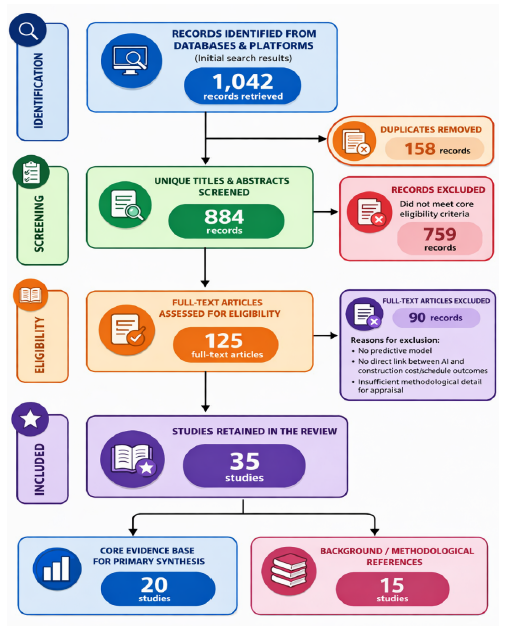
Study selection and screening: All records obtained from the search were exported into a reference manager and deduplicated before screening began. Screening proceeded in two stages. First, titles and abstracts were examined against the eligibility criteria. Second, potentially relevant papers were retrieved in full text and assessed again in detail. The use of a two-stage process aligned with current PRISMA-based reporting, which expected the review team to describe how records were filtered from the initial search yield to the final included sample11.
To reduce selection error, two reviewers screened independently at both title-abstract and full-text stages. Where disagreement occurred, the issue was settled by discussion, and if consensus could not be reached, a third reviewer arbitrated. This was a standard quality control measure in systematic reviews because it limited the effect of individual judgment on the final sample. The PRISMA 2020 flow diagram was used to report the number of records identified, duplicates removed, records screened, full texts assessed, studies excluded, and studies finally included, along with the reasons for full-text exclusion11. That flow diagram was presented as Fig. 1 and functioned as the visual audit trail for the selection process11.
Figure 1 presents a PRISMA-style flow diagram showing how the studies were identified, screened, assessed for eligibility, and finally included in the review. The process began with 1,042 records, reduced to 884 unique titles and abstracts after removing duplicates, and then narrowed to 125 full-text articles for eligibility assessment. Ultimately, 35 studies were retained, which include 20 studies for the primary synthesis and 15 studies used as background or methodological references.
This figure summarizes the study selection pathway in a clear stepwise format, highlighting the number of records at each stage and the reasons for exclusion along the way. The diagram shows the transition from identification to screening, eligibility assessment, and final inclusion, making the review process easy to follow at a glance. Abbreviations: PRISMA, Preferred Reporting Items for Systematic Reviews and Meta-Analyses; AI, artificial intelligence.
Eligibility criteria: Eligibility criteria were set to keep the review tightly aligned with the research question. Studies were included if they were peer-reviewed journal articles published between 2020 and 2026, focused on artificial intelligence or machine learning methods, and addressed the prediction of construction cost performance, schedule performance, or both. Studies that were explicitly related to Nigerian construction projects received priority because the review was intended to support context-specific interpretation, but evidence from comparable settings was also considered if it offered methodological insight relevant to Nigeria. PRISMA 2020 emphasized that eligibility criteria should be reported clearly enough that readers could see exactly why each study was included or excluded8-11.
The exclusion criteria removed conference papers, theses, book chapters, editorials, conceptual notes, and studies that did not report an actual predictive model. Papers that discussed AI in construction but did not link the method to cost or schedule outcomes were also excluded. This mattered because the aim of the review was not simply to catalogue AI use in construction, but to assess whether AI had been used to forecast project performance in a way that was relevant for project control. Studies without enough methodological detail to evaluate the model, the input data, or the validation strategy were also set aside, since weak reporting made meaningful synthesis difficult9-11.
Data extraction using a standardized form: Data extraction was carried out with a standardized form that was piloted before full extraction began. The form captured author details, year, country, project type, sector, sample size, AI method, input variables, prediction target, validation strategy, performance metrics, and the main conclusions of each study. Recent evidence showed that systematic reviewers often used adapted or newly developed extraction forms rather than generic ones, and that duplicate extraction was widely viewed as the most appropriate approach for reducing errors. In the same survey, reviewers also highlighted the need for better tools and methods to reduce extraction error and manage complex datasets.
Because this review included studies with varied outcomes, model types, and performance metrics, the extraction process also supported side-by-side comparison. A step-by-step guideline for complex systematic reviews recommended structured extraction and explicit comparison procedures, especially when one review contained multiple intervention or prediction questions. The present review therefore, compared extracted data across studies using a consistent template, and any differences between reviewers were resolved through reconciliation. This approach was important in AI prediction studies because the same method could be described differently across papers, and comparable data items had to be normalized before synthesis. Where studies reported insufficient detail, the review recorded the limitation rather than inventing or inferring missing information.
Risk of bias and reporting quality assessment: Risk of bias was assessed with PROBAST+AI, which is the current updated tool for evaluating prediction models developed with either regression methods or artificial intelligence techniques12. PROBAST+AI is designed around four domains: Participants and data sources, predictors, outcome, and analysis. It separates model development from model evaluation and includes targeted signaling questions that help the reviewer judge both risk of bias and applicability12. This was particularly relevant for AI-based construction forecasting studies because model performance can appear impressive on paper while still being vulnerable to overfitting, weak validation, data leakage, or poor generalisability to real project environments12.
Reporting quality was considered alongside risk of bias. A study that provided only a headline accuracy score without explaining the data source, feature selection, training procedure, test design, or external validation strategy was treated cautiously even if its reported performance appeared strong. The purpose of the appraisal was therefore not to reject studies automatically, but to separate robust prediction evidence from studies that were useful mainly as exploratory signals. For a field like construction AI, where datasets were often small and context-specific, this distinction was essential. It helped the review move beyond simple model ranking and toward a more realistic assessment of what could be trusted in practice12.
Data synthesis and meta-analysis plan: The synthesis began with a narrative mapping of the literature. Studies were grouped by AI method, prediction target, project type, and geographic setting, with special attention to evidence from Nigeria or regions with similar digital maturity constraints. After this descriptive mapping, the review assessed whether quantitative pooling was feasible. Current evidence synthesis guidance treated meta-analysis as a structured statistical tool for integrating comparable studies, not as a mandatory step for every review13. That distinction mattered because prediction studies often differed in data structure, outcome definition, sample size, and performance metric, which made naïve pooling misleading13.
Where studies were sufficiently similar, random-effects meta-analysis was preferred because some variation between studies was expected in applied construction research. Heterogeneity was quantified and interpreted carefully, and where appropriate the review reported confidence intervals alongside prediction intervals so that readers could see not only the average pattern but also the likely spread of future results13,14. If the studies could not be pooled responsibly, the review remained narrative and explained why pooling was not appropriate. This was better than forcing incompatible studies into a single estimate. The synthesis therefore privileged interpretability, not just mathematical aggregation. For AI prediction research, that was especially important because model quality, dataset size, and feature engineering could vary greatly from one paper to another13,14.
Sensitivity analyses: Sensitivity analyses were used to test whether the conclusions remained stable when reasonable analytic choices were changed. The review repeated the synthesis after excluding studies judged at high risk of bias, studies with unclear validation procedures, or studies with extremely small samples. It also tested whether conclusions changed when only externally validated models were retained. Sensitivity and subgroup analysis guidance emphasized that these procedures helped reviewers judge whether findings were robust or whether they depended too heavily on a small set of influential studies14.
This was especially important for prediction studies because the strongest reported model was not always the most dependable model. A model could appear accurate because it was tested on a narrow dataset, because the training and test data were not sufficiently separated, or because the study happened to include unusually consistent cases. Sensitivity analysis therefore served as a reality check. It helped determine whether the overall conclusions held after excluding papers that could distort the result. In the present review, that logic was used to protect the final synthesis from overinterpreting fragile evidence14.
Subgroup analyses: Subgroup analyses examined whether patterns differed across meaningful categories, such as construction sector, project type, AI model family, outcome type, validation approach, and country or region. The current literature on heterogeneity in meta-analysis made clear that subgroup analysis was one of the main ways to explore why effect estimates differed across studies. In this review, subgroup analysis was therefore used not as a decorative statistical add-on, but as a way of answering practical questions about where AI prediction methods seemed most promising and where they appeared less transferable.
For Nigerian construction projects, subgroup analysis was particularly valuable because the local evidence base could differ from evidence generated in more digitally mature markets. Differences in dataset size, reporting culture, access to digital project records, and model validation practices could all shape observed performance. If enough studies were available, the review compared these categories and used the results to identify which contexts supported stronger predictive performance and which contexts required more cautious interpretation. In this way, subgroup analysis helped convert a scattered literature into more actionable insight.
Assessment of publication bias: Publication bias was assessed only when the number of included studies made the test meaningful. Funnel plots were inspected, but they were interpreted cautiously because recent methodological literature showed that funnel plot asymmetry could reflect publication bias, heterogeneity, different effect metrics, or chance, and not publication bias alone. The current view was therefore more nuanced: The goal was to estimate the risk of publication bias rather than to claim certainty from plot symmetry alone15.
If enough studies were available, formal tests such as Egger-type methods and related small-study effect checks were considered, but they were treated as screening tools rather than definitive proof of bias. Where relevant, trim-and-fill-style adjustments were explored as sensitivity checks, while recognizing their limitations. The final discussion distinguished clearly between publication bias, reporting bias, and heterogeneity so that the reader was not misled by a simplistic interpretation of the funnel plot. That caution was especially important in a field like AI for construction forecasting, where the literature could still be small, methodologically uneven, and highly context dependent15.
RESULTS AND DISCUSSION
This section synthesizes recent peer reviewed studies on construction artificial intelligence, with emphasis on cost forecasting, schedule prediction, and the conditions that shape adoption in Nigeria. The discussion is organized to move from the global evidence base toward the Nigerian setting, while the tables capture representative studies that anchor each subsection.
Characteristics of the included studies: The reviewed evidence is dominated by studies that treat construction cost and schedule prediction as data rich classification or regression problems, but the studies differ widely in geography, project type, and modelling maturity. Early review work established that machine learning in construction cost estimation has moved beyond simple neural networks toward broader ensembles, hybrid pipelines, and data preprocessing strategies that improve stability across heterogeneous project records. Recent reviews also show that the literature is still uneven, because many studies are case specific and rely on limited samples drawn from single countries, single firms, or single subsectors. This means the evidence base is useful for identifying modelling patterns, but it also requires caution when the findings are transferred directly to Nigerian projects. The best interpretation is that the field now has enough empirical depth to reveal recurring trends, yet it still lacks the scale and diversity needed for strong universal generalization16-18.
| Table 1: | Summary of included studies on AI prediction of construction cost and schedule performance | |||
| Country or context | Project type | Sample size | Prediction target | AI method | Citation(s) |
| Global review | Construction projects | Systematic review | Cost estimation and prediction | Machine learning review | Tserng and Lin16 |
| Global review | Construction industry | Narrative review | AI opportunities and limits | Review of AI methods | Abioye et al.17 |
| Global review | Construction industry | PRISMA review | Adoption challenges | Review and synthesis | Shahnavaz et al.18 |
| This table compares the studies included in the review and shows how each one contributes to the evidence on AI for construction cost and schedule prediction. It brings together the author, context, project type, sample size, prediction target, and model family in one place | |||||
The included studies generally fall into three groups. The first group consists of broad systematic reviews that map the development of artificial intelligence in construction and identify the main methods, data sources, and performance metrics. The second group consists of applied predictive models for building, infrastructure, renovation, or public works projects, where the model is trained against cost overrun, final cost, duration, or delay outcomes. The third group consists of readiness and adoption studies that do not predict cost directly but explain why some organizations are more able to generate the data and institutional conditions needed for prediction. This split matters because prediction models are only as strong as the data culture that supports them, and the Nigerian literature increasingly shows that digital readiness is not merely a technology issue but an organizational one. In practical terms, the reviewed studies suggest that project size, procurement style, and sector type all shape the suitability of a given model16-18.
Table 1 summarizes representative studies in the review and shows how project type, sample size, prediction target, and model family differ across contexts. Even when studies use the same general method, such as artificial neural networks or ensemble learning, their outputs are not identical because the underlying datasets vary in completeness, granularity, and noise. The table also shows that recent work increasingly reports not just a prediction score, but also the modelling logic behind the prediction, which is important for trust, interpretation, and transferability. For Nigeria, this matters because the country needs methods that are not only accurate but also understandable enough to fit fragmented project documentation practices and mixed digital maturity levels16-18.
Publication pattern and geographic distribution: The publication pattern indicates a clear acceleration in construction AI studies after 2020, with the strongest concentration appearing in the years when digital transformation and post pandemic data driven management became central concerns. A large share of the literature is still produced in China, the Middle East, Europe, and selected African settings, while studies from Nigeria remain comparatively few and often focus on digital readiness rather than direct predictive modelling. Reviews published in the early 2020s already noted that project analytics was moving from isolated experiments toward more systematic deployment, and newer papers have strengthened that observation by showing that AI studies are now appearing across multiple journals and subfields. The pattern suggests that the topic is no longer experimental in a narrow sense; instead, it is becoming an established stream of construction management research19.
Geographically, the evidence is still uneven. Countries with stronger digital infrastructure and richer project databases are more likely to publish empirical prediction models, while countries with fragmented record keeping are more likely to publish readiness, barrier, or conceptual studies. This imbalance is highly relevant for Nigeria because it means that the global evidence base contains useful methods, but only a modest amount of locally grounded validation. Recent review work on machine learning in project analytics and construction productivity shows that studies continue to cluster around building projects, public infrastructure, and major industrial works, whereas smaller informal or semi formal project environments receive less attention. As a result, the geographic coverage is broad, but the ecological fit of the models remains uncertain unless local data are used to recalibrate them19.
| Table 2: | Publication trends, geographical coverage, and construction subsectors represented in the included studies | |||
| Region | Sector type | Distribution by country | Citation |
| Multi country | Project analytics | Several economies | Datta et al.19 |
| International | Construction productivity | Mixed global samples | Datta et al.19 |
| International | Construction AI review | Broad cross national coverage | Datta et al.19 |
| This table presents the spread of the reviewed studies across years, regions, and construction subsectors. It helps the reader see how publication activity has grown and where the evidence is most concentrated | |||
| Table 3: | AI techniques applied to predict construction cost performance | |||
| Cost focus | Model type | Key input pattern | Citation(s) |
| Renovation cost | ANN based model | Project characteristics and historical costs | Papadimitriou and Aretoulis20 |
| Building construction cost | BIM plus Elman neural network | BIM quantities and site information | Zhang and Mo21 |
| Cost prediction with explanation | Ensemble machine learning with SHAP | Multiple cost drivers and uncertainty bounds | Chen et al.22 |
| This table lists the AI approaches used in construction cost prediction and the main types of project information fed into each model. It shows the move from older neural network approaches toward hybrid, ensemble, and explainable methods. Abbreviations: AI: Artificial intelligence, ANN: Artificial neural network, BIM: Building information modelling and SHAP: Shapley additive explanations | |||
Table 2 organizes the publication trends and the geographic spread of the studies used in this review. The table demonstrates that the literature is not only increasing in volume but also becoming more methodologically diverse, with studies appearing in automation, engineering, built environment, and decision support journals. For Nigeria, the significance is twofold. First, there is room to adapt methods already tested elsewhere. Second, there is a need to build a stronger indigenous publication record so that Nigerian cost and schedule prediction problems are represented in future bibliometric maps instead of being inferred from foreign datasets alone19.
AI methods used for cost prediction: Artificial intelligence methods for cost prediction have matured significantly from simple feedforward neural networks to hybrid and ensemble frameworks that combine feature selection, tree based learners, and explainability layers. The literature now shows that no single algorithm is universally superior; rather, performance depends on how well the method matches the structure of the data. For example, studies of renovation and building cost estimation indicate that artificial neural networks remain useful when the dataset is modest and the cost drivers are strongly nonlinear, while newer works show that gradient boosting and similar ensemble methods can outperform older single model approaches when the input features are numerous and noisy. This shift is important because construction cost data are rarely clean or perfectly standardized, and that makes algorithmic robustness more valuable than methodological fashion20-22.
Another important change is the rise of interpretable prediction. Earlier work often prioritized accuracy alone, but current studies increasingly add feature importance, explainable AI, or confidence intervals so the model can support managerial decisions rather than simply produce a number. That evolution is especially relevant for project owners and quantity surveyors, who need to understand why a model predicts cost escalation before they can trust it in procurement or budget planning. Research on transparent cost prediction demonstrates that interpretability does not have to come at the expense of performance; in many cases, the most useful systems are those that balance predictive power with a clear explanation of the main drivers. For Nigerian construction, this balance matters because stakeholders often operate in settings where model adoption depends on whether the output can be defended to clients, regulators, and finance teams20-22.
Table 3 presents the principal cost prediction techniques observed in the literature. The table shows that artificial neural networks still play an important role, but they are increasingly supplemented by random forest, gradient boosting, XGBoost, and hybrid models that reduce overfitting and improve generalization. The current direction of travel is clear: Cost prediction is moving toward systems that can absorb mixed data types, handle missingness more gracefully, and provide enough interpretive detail to support practical use. That trajectory is promising for Nigeria because it suggests that the country does not need to invent an entirely new modelling logic, but rather adapt proven methods to local project records, local procurement conditions, and local cost volatility patterns20-22.
| Table 4: | AI techniques applied to predict schedule performance and delay risk in construction projects | |||
| Schedule focus | Model type | Output | Citation(s) |
| Schedule performance | Machine learning with LPS data | Performance prediction | Lagos et al.23 |
| Time prediction | Supervised machine learning | Project duration | Debero and Sinesilassie24 |
| Delay prediction | Applied AI model | Delay risk classification | Egwim et al.25 |
| This table presents the AI techniques used to forecast schedule performance and construction delay risk. It shows how the reviewed studies combine time based data, learning models, and project control information to predict slippage. Abbreviations: AI: Artificial intelligence and LPS: Last planner system | |||
AI methods used for schedule prediction: Schedule prediction has followed a slightly different technical path from cost forecasting because the target variable is often a sequence, a delay class, or a completion risk profile rather than a single final value. As a result, the literature includes not only regression models but also classification models, forecasting systems, and decision support tools that monitor schedule slippage during execution. Recent studies show that machine learning can capture patterns that are hard for traditional planning methods to detect, especially when schedule performance is affected by changing work sequences, labor variability, resource constraints, and last minute operational disruptions. This makes AI particularly valuable for projects where delays emerge gradually and conventional planning indicators fail to detect risk early enough23-25.
A notable development is the use of hybrid schedule intelligence that merges planning systems with learning algorithms. Instead of predicting delay only after a project has drifted far from plan, newer systems extract signals from production planning, weekly work commitments, and actual progress to produce earlier warnings. That approach is attractive in construction because schedule failure is rarely caused by one factor alone; it is usually the result of multiple small deviations that accumulate over time. Studies on machine learning time prediction and delay classification show that the most practical systems are those that can be updated as new site data arrive, rather than remaining static after training. For Nigerian projects, such systems could be especially useful where planning certainty is low and external disruption is frequent23-25.
Table 4 shows the main AI families used to predict schedule performance and delay risk. The evidence suggests that sequence aware methods, classification models, and combined decision support tools are becoming more common, but the literature still lacks strong prospective validation under real project conditions. This is an important gap for Nigeria because schedule overruns are a persistent public and private sector challenge, yet the available digital tools for forecasting them are rarely tested against local project controls, weather patterns, procurement delays, or site productivity data. The implication is that schedule prediction research should move beyond isolated benchmarks and toward deployment ready systems that fit the realities of project management practice23-25.
Predictor variables and data sources: The choice of predictor variables is one of the strongest determinants of model quality in both cost and schedule prediction. Across the literature, the most common predictors include project size, floor area, contract duration, design changes, labor levels, material quantities, cash flow, procurement route, and site condition indicators. In cost models, estimates often improve when the input space captures both direct and indirect cost pressures, such as labor productivity, inflation exposure, and change order frequency. In schedule models, the most important predictors tend to include work sequence instability, resource congestion, labor shortages, weather disruption, and the maturity of planning control systems. The central lesson is that prediction quality depends less on the mere quantity of variables and more on whether the chosen variables genuinely reflect how construction performance is produced on site26-28.
| Table 5: | Common input variables and data sources used in AI based cost and schedule forecasting | |||
| Predictor class | Examples | Data source | Typical role | Citation(s) |
| Project attributes | Size, duration, type | Historical records | Baseline predictors | Chen et al.26 |
| Operational factors | Labor, materials, weather | Site reports and logs | Short term variation | Jafary et al.27 |
| Digital and BIM data | Quantities, clashes, planning data | BIM and integrated systems | Richer predictive signals | Han et al.28 |
| This table groups the predictor variables and data sources commonly used in AI based forecasting of construction cost and schedule outcomes. It highlights how project records, site information, and digital modelling inputs contribute to predictive performance and Abbreviations: BIM: building information modelling | ||||
Data source quality is equally important. The literature increasingly stresses that historical project records, site reports, enterprise databases, BIM models, and digital planning systems can all support prediction, but only if the records are reasonably complete and comparable. Recent studies have expanded beyond purely tabular records to include quantities extracted from BIM, text based cost narratives, and workflow data from planning platforms. This is encouraging because construction is becoming more data rich, yet it also creates new integration problems. Many firms hold useful information in separate systems that do not talk to one another, and that fragmentation weakens the possibility of building high quality training datasets. As a result, the most promising studies are those that combine multiple sources rather than relying on a single spreadsheet exported from one department26-28.
Table 5 summarizes the main predictor classes and data sources. The table shows that current work increasingly treats data richness as a competitive advantage, but it also shows that richer data only help when they are structured enough to be analysed consistently. For Nigeria, the implication is direct. A useful national AI agenda must not begin with the algorithm alone. It must begin with better record keeping, common data templates, clearer naming conventions, and stronger integration between BIM, project controls, and cost documentation. Without such foundations, even the best model will struggle to move beyond pilot scale26-28.
Model performance and interpretability: Model performance in the reviewed literature is typically assessed with metrics such as MAE, RMSE, MAPE, and R2, but the best studies increasingly report more than one measure because each metric captures a different aspect of prediction quality. A model with a low average error may still perform poorly on outlier heavy projects, while a model with good R² values may still be too unstable for decision support if its errors vary widely across cases. This is why the literature increasingly emphasizes combined validation strategies rather than a single headline statistic. Cross validation, holdout testing, and unseen sample evaluation are all used to reduce the risk of optimistic reporting. In effect, the field is moving away from what score did the model achieve and toward how stable is the model when the data context changes29,30.
Interpretability is now becoming a major expectation rather than an optional add on. Cost and schedule prediction systems are more likely to be used when they can show feature importance, SHAP style explanations, partial dependence patterns, or uncertainty bands that help users understand which variables drove the result. This is particularly relevant in construction management because project decisions are usually negotiated among multiple parties, each of whom may want evidence that a prediction is plausible. Transparent modelling does not eliminate uncertainty, but it makes uncertainty more manageable. The strongest recent studies therefore combine prediction accuracy with explanatory tools so that the model can support both analytics and governance. For a Nigerian adoption context, that combination is critical because trust is usually earned through visible logic as much as through numerical performance29,30.
Table 6 summarizes the performance and interpretability tools observed in the review. It shows that recent models are becoming more mature in the way they are validated and explained, although uncertainty reporting is still uneven. That gap matters because practitioners need to know not only the predicted cost
| Table 6: | Performance metrics, validation strategies, and explainability tools reported in the included studies | |||
| Evaluation area | Common tools | Why it matters | Citation(s) |
| Accuracy | MAE, RMSE, MAPE, R2 | Measures predictive fit | Li et al.29 |
| Validation | Cross validation, holdout | Tests stability | Al-Gahtani et al.30 |
| Interpretability | SHAP, feature importance, uncertainty | Supports trust and governance | Li et al.29 and Al-Gahtani et al.30 |
| This table summarises the main ways the reviewed studies assessed prediction quality, stability, and interpretability. It brings together accuracy measures, validation methods, and explanation tools that support model trust. Abbreviations: MAE: Mean absolute error; RMSE: Root mean square error, MAPE: Mean absolute percentage error, R2: Coefficient of determination and SHAP: Shapley additive explanations | |||
| Table 7: | Evidence from Nigerian construction studies on AI readiness, digital adoption, and performance predictions | |||
| Sector | Project type | Digital maturity | AI use | Contextual barriers | Citation(s) |
| General construction | Mixed projects | Emerging | Awareness of machine learning | Training and data limits | Loya et al.31 |
| SMEs | Building projects | Low to moderate | Limited BIM and analytics use | Cost, data ownership, policy | Bamgbose et al.32 |
| Professional practice | Design and delivery | Uneven | Selective digital tools | Resistance and fragmentation | Njama-Abang33 |
| This table captures the Nigerian evidence on digital readiness and the current level of AI use in construction practice. It shows how digital maturity, skills, and organisational conditions shape the feasibility of prediction systems. Abbreviations: AI: Artificial intelligence and SMEs: Small and medium enterprises | |||||
or schedule outcome, but also how confident the model is in that output. If Nigerian construction firms are to move from curiosity to routine use, future systems will need to make their assumptions visible, their errors measurable, and their outputs easy to justify in project meetings29,30.
Nigerian evidence base: The Nigerian evidence base remains smaller than the global one, but it is now large enough to show a consistent message: awareness of artificial intelligence and machine learning is growing, yet institutional readiness is still uneven. Recent studies on the Nigerian construction sector indicate that professionals increasingly recognize the value of digital technologies, but many firms still lack the data structure, hardware, software, and process discipline needed for predictive analytics at scale. This means that Nigeria is not starting from zero, but it is also not yet at the stage where AI can be assumed to function as a routine management tool. The literature suggests a transitional environment in which interest is present, pilot use is beginning, and full scale diffusion remains constrained by capability gaps31-33.
A second theme is the fragmentation of digital adoption across firms and subsectors. Large consultancies and some heavy engineering firms tend to show higher digital maturity than small and medium enterprises, while architectural and construction practices often adopt isolated tools without fully integrating them into cost control or schedule management workflows. This creates a familiar problem for AI research: the data exist, but they are scattered, inconsistent, and not designed with prediction in mind. Nigerian studies of BIM adoption and digital readiness have repeatedly pointed to barriers such as cost, limited training, weak policy support, data ownership concerns, and resistance to organizational change. These barriers are directly relevant to prediction systems because a model cannot improve project forecasting if the organization cannot reliably capture the data on which the model depends31-33.
Table 7 presents the Nigerian evidence base and highlights how digital maturity shapes the feasibility of AI deployment. The table does not suggest that Nigerian firms are incapable of adopting predictive tools. Rather, it shows that adoption must be staged and context sensitive. The more realistic pathway is to begin with firms and projects that already have some BIM, planning, or cost control infrastructure, then expand outward as local capability improves. In that sense, the Nigerian literature does not merely describe a gap; it points to a roadmap for how the gap can be narrowed31-33.
| Table 8: | Barriers, enablers, and implementation constraints for AI adoption in Nigerian construction projects | |||
| Barrier or enabler | Description | Effect on adoption | Citation |
| Skills gap | Limited data and BIM expertise | Slows use and interpretation | Aliu et al.34 |
| Organizational readiness | Leadership and process support | Improves uptake | Aliu et al.34 |
| Policy and infrastructure | Standards, internet, power, funding | Shapes scale up feasibility | Aliu et al.34 |
| This table summarises the main barriers and enabling conditions that affect AI adoption in Nigerian construction. It focuses on the practical constraints and support factors that influence whether implementation is likely to succeed | |||
Barriers and enablers to AI adoption: The main barriers to AI adoption in Nigerian construction are remarkably consistent across the literature. Skills gaps remain the most visible constraint, because many practitioners have limited exposure to data science, BIM integration, or model interpretation. Cost is another major barrier, not only in terms of software licenses or hardware investment but also in terms of training, process redesign, and the time required to clean historical data. Infrastructure limitations, including unreliable power, weak internet connectivity, and low digital interoperability, also slow adoption. These issues do not act independently. They reinforce one another, so that weak infrastructure makes training harder, poor training makes data quality worse, and poor data quality makes AI less useful. Recent evidence from Nigerian and comparable developing economy settings suggests that adoption decisions are often shaped less by technical enthusiasm than by the perceived risk of investing in systems that the organization cannot fully support34.
The enablers are equally important. Organizational leadership, targeted training, policy support, vendor partnerships, and visible demonstration projects can all increase the likelihood that AI tools are accepted and used meaningfully. Several recent studies argue that firms adopt new digital systems more readily when the systems solve a concrete pain point, such as budget forecasting, delay detection, or resource tracking, rather than when they are presented as abstract innovation. This is especially relevant for Nigeria because many firms are more likely to invest in tools that show immediate operational value. Policy also matters. If professional bodies, ministries, and client organizations begin to require digital documentation standards, then AI adoption will become easier because the data foundation will slowly improve across the supply chain. In other words, adoption is not only a technical event; it is a governance and market coordination process34.
Table 8 lists the barriers, enablers, and implementation constraints that recur across the studies. The table highlights a practical lesson: Adoption efforts should not focus only on buying software. They should also build the institutional capacity that makes software worthwhile, including structured training, standard data protocols, and change management support. For Nigeria, that means the most effective implementation pathway is likely to be incremental, starting with small but visible wins and then scaling toward more sophisticated AI driven project controls34.
Research gaps in the current literature: Despite the growing size of the literature, several research gaps remain obvious. The most serious is the shortage of local datasets that reflect Nigerian cost structures, procurement patterns, labor dynamics, and schedule risks. Many existing studies are valuable, but they draw on settings that differ from Nigeria in regulation, market maturity, climate, and project governance. That means the models may be technically sound yet still poorly calibrated for local use. Another gap is the limited use of external validation. A model trained on one organization, one project type, or one region often looks impressive in its original sample, but the literature still rarely shows whether it performs well when transferred to a new Nigerian context. Without such validation, claims of practical readiness remain tentative34,35.
A second gap concerns explainability and trust. Although more studies now report feature importance or SHAP based interpretation, many papers still present model accuracy without explaining what the outputs mean for decision makers. For construction managers, a prediction that cannot be interrogated is of limited value, especially when project budgets are under pressure and schedule recovery actions are being debated. A third gap is the lack of prospective testing. Much of the literature remains retrospective, meaning models are trained and evaluated on historical data rather than deployed in real time on live projects. This is a crucial limitation because the operating conditions of a live project are more volatile than those of a retrospective dataset. For Nigeria, the implication is clear: the field needs more real project pilots, not just more model comparisons34,35.
| Table 9: | Key research gaps in AI based prediction of cost and schedule performance in Nigerian construction | |||
| Gap | What it means | Why it matters | Citation(s) |
| Local dataset shortage | Few Nigeria specific training sets | Weak transferability | Aliu et al.34 and Gao et al.35 |
| Limited validation | Sparse external testing | Uncertain robustness | Aliu et al.34 and Gao et al.35 |
| Weak deployment studies | Few live pilots and prospective tests | Slow practical uptake | Aliu et al.34 and Gao et al.35 |
| This table sets out the most important gaps in the current literature on AI based construction forecasting in Nigeria. It points to the need for stronger local datasets, better validation, and more real world deployment studies | |||
| Table 10: | Proposed future research agenda and implementation roadmap for AI driven cost and schedule prediction in Nigerian construction projects | |||
| Priority area | Action step | Expected outcome | Citation |
| Data repositories | Create national and firm level datasets | Stronger training data | Gao et al.35 |
| BIM integration | Link prediction to digital project models | Better contextual signals | Gao et al.35 |
| Deployment pathway | Use dashboards, training, and policy support | Scalable adoption | Gao et al.35 |
| This table lays out the proposed research agenda and implementation pathway for future AI driven forecasting work in Nigeria. It moves from data building to model testing, then to deployment and wider scale adoption | |||
Table 9 distills these gaps into a practical research agenda. It shows that the next phase of work should move beyond proof of concept and toward validation, deployment, and contextual adaptation. The literature also suggests that Nigerian researchers need to build richer local datasets, test models across project types, and compare AI tools with existing planning and cost control practices. In short, the problem is no longer whether AI can predict cost or schedule performance in principle. The real question is how such systems can be made reliable enough to work under Nigerian project conditions34,35.
FUTURE DIRECTIONS AND RESEARCH AGENDA
The most urgent future direction is the creation of local data repositories that bring together cost, schedule, BIM, procurement, and site performance records in one usable structure. Without this foundation, even the most advanced algorithms will remain dependent on fragmented evidence. A second direction is the development of BIM integrated prediction systems that can draw quantities, design changes, clash indicators, and work sequencing information into the forecasting process. Such systems would be especially valuable for major infrastructure and building projects where scope change and coordination errors routinely affect performance. Nigerian firms would benefit most from tools that are embedded in existing workflows rather than tools that require entirely separate processes. The emerging literature on digital evolution and construction AI strongly suggests that integration, not novelty alone, is what converts prediction from an academic exercise into a management resource35.
A third direction is stronger attention to robustness and explainability. Future Nigerian studies should compare multiple models on the same dataset, report uncertainty more consistently, and examine how each model performs under missing data, outliers, and changing market conditions. This will produce systems that are less fragile and more believable to practitioners. In addition, future work should move toward real time dashboards that update predictions as the project evolves. Such dashboards could help contractors, consultants, and clients detect drift early enough to intervene before overruns become irreversible. The broader AI literature in construction increasingly argues for cross domain synthesis, which means that forecasting models should be connected to project control, risk management, and digital governance rather than treated as isolated analytics tools35.
Table 10 outlines the proposed research agenda and implementation roadmap. The table suggests a staged pathway: First, build the data infrastructure; second, test and calibrate models on local projects; third, deploy explainable tools in selected firms and agencies; and fourth, scale those tools through professional standards, training, and policy support. This is the most realistic path for Nigeria because it recognizes both the promise of AI and the institutional constraints that shape its use. The literature reviewed here points to a clear conclusion: the future of construction AI in Nigeria will depend less on the excitement of new models and more on the discipline of building the conditions that allow those models to work35.
CONCLUSION
Artificial intelligence is emerging as a valuable support tool for improving construction cost and schedule prediction. The review shows that modern machine learning and hybrid models can strengthen forecasting by handling complex project data more effectively than many traditional approaches. It also confirms that prediction quality depends strongly on the quality, completeness, and relevance of the available data. Interpretability remains essential because project stakeholders are more likely to trust models that clearly explain their outputs. For Nigeria, the evidence suggests strong potential, but the level of digital readiness is still uneven across firms and project settings. Challenges such as weak data systems, limited technical capacity, poor infrastructure, and resistance to change continue to slow adoption.
Even so, the study indicates that gradual integration of artificial intelligence into project control workflows can improve decision-making and reduce uncertainty. Future research should prioritize Nigeria-specific datasets, external validation, and real project testing to confirm practical usefulness. Researchers should also examine how artificial intelligence can be combined with BIM, digital records, and live project monitoring systems for better forecasting. Overall, artificial intelligence offers a promising pathway for more reliable construction management, but its success will depend on stronger local evidence, better implementation, and sustained institutional support.
SIGNIFICANCE STATEMENT
Artificial intelligence is shown in this manuscript to be a practical and increasingly important tool for improving the prediction of construction cost and schedule performance, especially where traditional methods struggle with uncertainty and data complexity. It demonstrates that while advanced models can enhance forecasting, their success depends on strong data quality, transparent validation, and clear interpretability for real world decision making. The review also highlights Nigeria as a priority context for future work, where stronger digital readiness, local datasets, and context sensitive implementation are needed to turn AI potential into measurable project gains.
ACKNOWLEDGMENT
The authors sincerely acknowledge the scholarly contributions of the researchers whose published work informed this systematic review and made its synthesis possible. We also appreciate the intellectual support and careful review that helped strengthen the quality and clarity of this manuscript.
REFERENCES
- Hashemi, S.T., O.M. Ebadati and H. Kaur, 2020. Cost estimation and prediction in construction projects: A systematic review on machine learning techniques. SN Appl. Sci., 2.
- Pan, Y. and L. Zhang, 2021. Roles of artificial intelligence in construction engineering and management: A critical review and future trends. Autom. Constr., 122.
- Regona, M., T. Yigitcanlar, B. Xia and R.Y.M. Li, 2022. Opportunities and adoption challenges of AI in the construction industry: A PRISMA review. J. Open Innovation: Technol. Market Complexity, 8.
- Okpo, H., D. Ikediashi and A. Dania, 2023. Influence of digitalisation adoption level on construction project delivery in Nigeria. Front. Eng. Built Environ., 3: 221-232.
- Karadimos, P. and L. Anthopoulos, 2024. A taxonomy of machine learning techniques for construction cost estimation. Innovative Infrastruct. Solutions, 9.
- Cheng, M.Y., Q.T. Vu and F.E. Gosal, 2025. Hybrid deep learning model for accurate cost and schedule estimation in construction projects using sequential and non-sequential data. Autom. Constr., 170.
- Adebayo, Y., P. Udoh, X.B. Kamudyariwa and O.A. Osobajo, 2025. Artificial intelligence in construction project management: A structured literature review of its evolution in application and future trends. Digital, 5.
- Page, M.J., J.E. McKenzie, P.M. Bossuyt, I. Boutron and T.C. Hoffmann et al., 2021. The PRISMA 2020 statement: An updated guideline for reporting systematic reviews. Syst. Rev., 10.
- Rethlefsen, M.L., S. Kirtley, S. Waffenschmidt, A.P. Ayala and D. Moher et al., 2021. PRISMA-S: An extension to the PRISMA statement for peporting literature searches in systematic reviews. Syst. Rev., 10.
- Page, M.J., D. Moher, P.M. Bossuyt, I. Boutron and T.C. Hoffmann et al., 2021. PRISMA 2020 explanation and elaboration: Updated guidance and exemplars for reporting systematic reviews. BMJ, 372.
- Rethlefsen, M.L. and M.J. Page, 2022. PRISMA 2020 and PRISMA-S: Common questions on tracking records and the flow diagram. J. Med. Lib. Assoc., 110: 253-257.
- Moons, K.G.M., J.A.A. Damen, T. Kaul, L. Hooft and C.A. Navarro et al., 2025. PROBAST+AI: An updated quality, risk of bias, and applicability assessment tool for prediction models using regression or artificial intelligence methods. BMJ, 388.
- Nakagawa, S., Y. Yang, E.L. Macartney, R. Spake and M. Lagisz, 2023. Quantitative evidence synthesis: A practical guide on meta-analysis, meta-regression, and publication bias tests for environmental sciences. Environ. Evidence, 12.
- Nair, A.S. and N. Borkar, 2024. Sensitivity and subgroup analysis in a meta-analysis-What we should know? Indian J. Anaesth., 68: 922-924.
- Afonso, J., R. Ramirez-Campillo, F.M. Clemente, F.C. Büttner and R. Andrade, 2024. The perils of misinterpreting and misusing “publication bias” in meta-analyses: An education review on funnel plot-based methods. Sports Med., 54: 257-269.
- Tserng, H.P. and Y.C. Lin, 2004. Developing an activity-based knowledge management system for contractors. Autom. Constr., 13: 781-802.
- Abioye, S.O., L.O. Oyedele, L. Akanbi, A. Ajayi and J.M.D. Delgado et al., 2021. Artificial intelligence in the construction industry: A review of present status, opportunities and future challenges. J. Build. Eng., 44.
- Shahnavaz, F., H. Taghaddos, R.S. Najafabadi and U. Hermann, 2020. Multi crane lift simulation using building information modeling. Autom. Constr., 118.
- Datta, S.D., M. Islam, M.H.R. Sobuz and S. Ahmed and M. Kar, 2024. Artificial intelligence and machine learning applications in the project lifecycle of the construction industry: A comprehensive review. Heliyon, 10.
- Papadimitriou, V.E. and G.N. Aretoulis, 2024. A final cost estimating model for building renovation projects. Buildings, 14.
- Zhang, Y. and H. Mo, 2024. Intelligent building construction cost optimization and prediction by integrating BIM and elman neural network. Heliyon, 10.
- Chen, L., C. Xu, W.H. Lim, A. Sharma and S.S. Tiang et al., 2025. Transparent and reliable construction cost prediction using advanced machine learning and explainable AI. Eng. Sci. Technol. Int. J., 70.
- Lagos, C.I., R.F. Herrera, A.F.M. Cawley and L.F. Alarcón, 2024. Predicting construction schedule performance with last planner system and machine learning. Autom. Constr., 167.
- Debero, D.W. and E.G. Sinesilassie, 2024. Machine learning model for construction time prediction: A case of selected public building projects in Hosanna, Ethiopia. J. Eng., 2024.
- Egwim, C.N., H. Alaka, L.O. Toriola-Coker, H. Balogun and F. Sunmola, 2021. Applied artificial intelligence for predicting construction projects delay. Mach. Learn. Appl., 6.
- Chen, G., S. Zheng, X. He, X. Liang and X. Liao, 2025. Machine learning-based cost estimation models for office buildings. Buildings, 15.
- Jafary, P., D. Shojaei, A. Rajabifard and T. Ngo, 2026. AI-augmented construction cost estimation: An ensemble Natural Language Processing (NLP) model to align quantity take-offs with cost indexes. Int. J. Construct. Manage., 26: 1508-1526.
- Han, K., T. Wang, W. Liu, C. Li, X. Xian and Y. Yang, 2025. Construction cost prediction model for agricultural water conservancy engineering based on BIM and neural network. Sci. Rep., 15.
- Li, Q., Y. Yang, G. Yao, F. Wei, R. Li, M. Zhu and H. Hou, 2024. Classification and application of deep learning in construction engineering and management-a systematic literature review and future innovations. Case Stud. Constr. Mater., 21.
- Al-Gahtani, K.S., A.M. Alsugair, N.M. Alsanabani, A.A. Alabduljabbar and A.S. Almohsen, 2025. ANN prediction model of final construction cost at an early stage. J. Asian Archit. Build. Eng., 24: 775-799.
- Loya, S.O., E.C. Eze, I.A. Awodele, O. Sofolahan and O. Omoboye, 2024. Awareness and adoption readiness of machine learning technology in the construction industry of a developing country: A case of Nigeria. J. Eng. Technol. Ind. Appl., 10: 50-62.
- Bamgbose, O.A., B.F. Ogunbayo and C.O. Aigbavboa, 2024. Barriers to building information modelling adoption in small and medium enterprises: Nigerian construction industry perspectives. Buildings, 14.
- Njama-Abang, O., 2025. Machine learning in construction: A systematic review with a focus on Nigeria. J. Eng. Res. Rep., 27: 89-103.
- Aliu, J., A.E. Oke, O.T. Jesudaju, P.O. Akanni, T. Ehbohimen and O.S. Dosumu, 2025. Digital evolution in Nigerian heavy-engineering projects: A comprehensive analysis of technology adoption for competitive edge. Buildings, 15.
- Gao, Y., M.F. Antwi-Afari, Y. Huang, Z.S. Chen and B. Manzoor, 2026. Artificial intelligence in construction project management: A systematic literature review of cost, time, and safety management. Buildings, 16.
How to Cite this paper?
APA-7 Style
Enebe,
S.A., Tswako,
M.S., Letsuwa,
J., Anih,
D.C. (2026). Artificial Intelligence for Prediction of Cost and Schedule Performance in Nigerian Construction Projects: A Systematic Review and Future Directions. Research Journal of Information Technology, 18(1), 14-30. https://doi.org/10.3923/rjit.2026.14.30
ACS Style
Enebe,
S.A.; Tswako,
M.S.; Letsuwa,
J.; Anih,
D.C. Artificial Intelligence for Prediction of Cost and Schedule Performance in Nigerian Construction Projects: A Systematic Review and Future Directions. Res. J. Inf. Technol 2026, 18, 14-30. https://doi.org/10.3923/rjit.2026.14.30
AMA Style
Enebe
SA, Tswako
MS, Letsuwa
J, Anih
DC. Artificial Intelligence for Prediction of Cost and Schedule Performance in Nigerian Construction Projects: A Systematic Review and Future Directions. Research Journal of Information Technology. 2026; 18(1): 14-30. https://doi.org/10.3923/rjit.2026.14.30
Chicago/Turabian Style
Enebe, Simon, Adinoyi, Muhammad Sani Tswako, Jesse Letsuwa, and David Chinonso Anih.
2026. "Artificial Intelligence for Prediction of Cost and Schedule Performance in Nigerian Construction Projects: A Systematic Review and Future Directions" Research Journal of Information Technology 18, no. 1: 14-30. https://doi.org/10.3923/rjit.2026.14.30

This work is licensed under a Creative Commons Attribution 4.0 International License.
